

Product Name: 4,4′-Methylene-bis(2,6-diethylaniline)
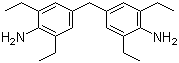
Synonyms: 4,4′-Methylenebis (2,6-diethyIaniline); 4,4′-Methylenebis(2,6-diethylaniline); 4,4-Methylenebis(2,6-diethyIaniline)
CAS RN.: 13680-35-8
EINECS: 237-185-4
Molecular Weight: 310.4763
Molecular Formula: C21H30N2
Density: 1.019g/cm3
Melting Point(℃): 88-91℃
Boiling Point(℃): 463.5°C at 760 mmHg
Flash Point(℃): 281°C
Purity: >98.0% (HPLC)
Polyurethane Elastomer, Polyurea Resin Curing Agent And Epoxy Curing Agent.
Introduction to 4,4′-Methylenebis(2,6-diethylaniline) (MDEA)
4,4′-Methylenebis(2,6-diethylaniline) (MDEA) [CAS No. 13680-35-8] is a specialized aromatic amine with essential applications in industries that require stability, chemical resistance, and durability in their products. As a primary material in the production of polyurethane, epoxy resins, and specialty coatings, MDEA plays a pivotal role in delivering high-performance features.
Symb ChemTech: Leading MDEA Manufacturer in China
Symb ChemTech, recognized as China’s main producer of MDEA, is a trusted supplier for global industrial clients. With a focus on delivering high-quality, reliable chemical materials, Symb ChemTech emphasizes quality control, sustainable production methods, and rigorous testing standards to meet both domestic and international requirements.
Key Features and Benefits of MDEA
- High Chemical Stability: MDEA provides outstanding resistance against environmental and chemical degradation, ideal for applications exposed to harsh conditions.
- Versatility in Applications: This compound is particularly suited for use in polyurethane and epoxy resins, offering improved flexibility and enhanced performance in various formulations.
- Quality and Purity Assurance: Symb ChemTech ensures each batch of MDEA meets stringent purity and performance criteria, addressing the high standards set by global industries.
Industrial Applications of MDEA
Polyurethane Industry
MDEA acts as an effective curing agent in polyurethane applications, enhancing durability and resistance. Industries rely on MDEA-based polyurethane for heavy-duty uses, particularly in protective and structural applications.
Epoxy Resins and Coatings
In epoxy systems, MDEA contributes to superior adhesion, chemical stability, and mechanical strength, making it suitable for industrial coatings, adhesives, and electrical encapsulations.
Specialty Manufacturing
MDEA is used in specialty chemical production where stability and performance are crucial, including advanced polymers and composites.
Why Choose Symb ChemTech for MDEA?
Symb ChemTech is dedicated to delivering MDEA with consistent quality, timely supply, and competitive pricing. By sourcing from Symb ChemTech, industries gain access to a high-standard manufacturer committed to advancing innovation and maintaining quality across its product offerings. Symb ChemTech’s experienced team and state-of-the-art production facilities ensure MDEA products meet the rigorous demands of global markets.
For companies seeking a reliable, high-quality source of 4,4′-Methylenebis(2,6-diethylaniline) (MDEA) [13680-35-8], Symb ChemTech stands out as the leading Chinese manufacturer, offering unmatched expertise, quality, and industry knowledge.
MDEA (4,4′-Methylenebis(2,6-diethylaniline))
Premium Chemical Solutions for High-Performance Applications
When precision matters in polymer chemistry, professionals worldwide trust Symb ChemTech for premium-grade MDEA. With over two decades of chemical excellence, we deliver the highest quality aromatic diamine solutions.
Request Your Quote Today
Key Benefits
Superior Thermal Stability
Maintains performance up to 200°C for demanding high-temperature applications
Enhanced Mechanical Properties
Exceptional strength, durability, and abrasion resistance in cured systems
Excellent Chemical Resistance
Outstanding resistance to chemicals, solvents, and environmental stress
Consistent Quality
99%+ purity with rigorous batch-to-batch quality control
Technical Support
Expert guidance from formulation to production scale-up
Global Reliability
Worldwide supply chain with 20+ years of industry experience
What is MDEA (4,4′-Methylenebis(2,6-diethylaniline))?
MDEA, scientifically known as 4,4′-Methylenebis(2,6-diethylaniline), is a high-performance aromatic diamine compound that serves as a critical building block in advanced polymer chemistry. This versatile chemical intermediate, identified by CAS number 13680-35-8, has become indispensable in the production of polyurethane elastomers, epoxy resins, and specialized coating systems where superior mechanical properties and thermal stability are paramount.
The molecular structure of MDEA features two aniline groups connected by a methylene bridge, with ethyl substituents positioned at the 2,6-positions of each aromatic ring. This unique configuration provides exceptional reactivity with isocyanates and epoxy groups while imparting remarkable thermal and chemical resistance to the resulting polymer networks.
In the polyurethane industry, MDEA functions as a chain extender, facilitating the formation of hard segments that contribute to the material’s mechanical strength, abrasion resistance, and thermal stability. When used in epoxy systems, it acts as a curing agent, promoting cross-linking reactions that result in thermoset networks with exceptional performance characteristics.
Technical Specifications & Properties
Understanding the precise technical characteristics of MDEA is crucial for successful application development and quality control. Symb ChemTech provides comprehensive technical data to support your formulation efforts.
| Property | Specification | Test Method |
|---|---|---|
| Chemical Name | 4,4′-Methylenebis(2,6-diethylaniline) | – |
| CAS Number | 13680-35-8 | – |
| EC Number | 237-185-4 | – |
| Molecular Formula | C₂₁H₃₀N₂ | – |
| Molecular Weight | 310.48 g/mol | – |
| Appearance | Light yellow to amber solid | Visual |
| Purity | ≥99.0% | GC Analysis |
| Melting Point | 88-90°C | DSC |
| Moisture Content | ≤0.5% | Karl Fischer |
| Ash Content | ≤0.1% | Gravimetric |
Applications of MDEA in Industry
The versatility of MDEA as both a polyurethane chain extender and epoxy curing agent has established it as a cornerstone chemical in numerous high-performance applications across diverse industries.
Polyurethane Chain Extender
Essential for creating segmented copolymers with exceptional mechanical properties. Used in automotive seals, aerospace components, and industrial elastomers where durability and temperature resistance are critical.
Epoxy Curing Agent
Provides high-temperature performance and chemical resistance in structural composites, adhesives, and protective coatings. Ideal for aerospace, electronics, and marine applications.
High-Performance Elastomers
Enables production of elastomers with superior tear strength, abrasion resistance, and thermal stability for mining equipment, oil & gas applications, and heavy-duty transportation.
Specialty Coatings
Contributes to weather resistance, chemical protection, and long-term durability in protective coatings for infrastructure, marine environments, and industrial equipment.
Industries We Serve
Symb ChemTech’s MDEA serves as a critical component across diverse industries where high-performance materials are essential for success.
Automotive
Sealing systems, suspension components, interior applications
Aerospace
Aircraft seals, composite structures, space applications
Construction
Structural adhesives, protective coatings, waterproofing
Electronics
Encapsulation, PCB applications, thermal management
Marine
Offshore platforms, ship hulls, saltwater resistance
Industrial
Heavy machinery, mining equipment, chemical processing
Frequently Asked Questions
MDEA should be stored in a cool, dry location away from direct sunlight and heat sources. The recommended storage temperature range is 15-25°C with relative humidity below 60%. Containers should be tightly sealed to prevent moisture absorption. When stored properly, MDEA maintains its specifications for 24 months.
MDEA usage levels typically range from 10-30% by weight of the total formulation, depending on application requirements. Higher levels provide increased hardness and thermal stability, while lower levels maintain flexibility. The NCO:NH ratio should be maintained between 0.95:1 and 1.05:1 for optimal properties.
Yes, MDEA can be successfully combined with other chain extenders to optimize specific properties. Common combinations include MDEA with glycols for improved low-temperature flexibility, or with other aromatic diamines for enhanced thermal stability. Compatibility testing is recommended for new combinations.
Gas chromatography is the primary method for purity determination and impurity analysis. Karl Fischer titration provides accurate moisture content measurement. Differential scanning calorimetry (DSC) confirms identity and provides thermal stability information. All methods should be validated for precision and accuracy.
Get Your MDEA Quote Today
Ready to experience superior performance and reliability? Our technical experts are standing by to discuss your requirements and provide customized solutions.
Technical Support
24/7 expert consultation available
+86-138-3717-8289
Email Inquiry
Get responses within 24 hours
technical@symbchem.com
Online Resources
Technical literature and guides
www.symbchem.com