

Microcellular plastics represent a groundbreaking advancement in polymer foaming technology. Characterized by ultra-fine cell structures with diameters ranging from 0.01 to 10 μm and densities of 10⁹–10¹⁵ cells/cm³, these materials leverage supercritical foaming techniques to achieve unprecedented performance. Unlike conventional polymer foams, microcellular plastics offer superior impact strength, lightweight properties, sound insulation, and thermal retention—making them ideal for automotive, aerospace, medical devices, sporting goods, and packaging industries.
The Four Stages of Microcellular Foaming
Successful microcellular foaming hinges on four critical stages:
- Homogeneous System Formation: Creation of a gas-saturated polymer matrix.
- Bubble Nucleation: Initiation of cell formation.
- Cell Growth: Expansion of nucleated bubbles.
- Foam Stabilization: Solidification into the final structure.
The initial homogeneous phase is particularly vital. Here, achieving complete gas dissolution and eliminating pre-existing bubbles are essential to prevent irregular cell growth. The rheological properties of this phase—especially melt viscosity—directly influence pressure drop rates and non-equilibrium dynamics during foaming.
Supercritical CO₂ (scCO₂) outperforms N₂ as a blowing agent due to its higher solubility and diffusion rates in polymers, enabling denser and more uniform cell structures.
Key Factors Influencing Homogeneous Phase Rheology
1. Temperature: The Viscosity Regulator
Temperature critically affects melt viscosity and cell morphology:
- Lower temperatures (within optimal range) increase polymer chain entanglement, reduce free volume, and elevate viscosity—resulting in smaller cells and higher densities.
- scCO₂ solubility rises at lower temperatures, enhancing plasticization. However, excessively low temperatures increase surface tension, hindering diffusion.
- The optimal window lies above the polymer’s glass transition temperature (Tg) (to enable chain mobility) and below the foaming agent’s escape temperature (to prevent bubble collapse).
2. Pressure: Balancing Viscosity and Solubility
- Increased pressure compresses free volume between polymer chains, raising viscosity.
- Higher pressure also boosts scCO₂ solubility and diffusion, enhancing plasticization.
- Studies reveal an exponential relationship between shear viscosity and pressure (modeled via the Cross-Carreau equation). However, this correlation weakens at high temperatures/concentrations due to competing effects.
3. scCO₂ Dissolution: Plasticization Powerhouse
- scCO₂ reduces intermolecular forces and disentangles polymer chains, significantly lowering viscosity.
- Dissolution levels directly impact cell density and uniformity. Near saturation thresholds, effects become unstable.
- Industry Challenge: Precise dissolution control remains difficult due to thermal lag in reactors and mismatched CO₂ flow dynamics.
4. External Fields: Accelerating Homogenization
- Shear or vibrational fields reduce apparent viscosity and shorten homogenization time.
- Low shear rates markedly decrease viscosity, but high rates cause cell orientation defects.
- Research by South China University of Technology demonstrates that vibrational fields (e.g., electromagnetic mixing) optimize energy/momentum balance, reduce elasticity, and improve product quality.
Industry Outlook and Innovations
Microcellular plastics are gaining traction as industries prioritize lightweight, eco-friendly materials. Key developments include:
- Advanced Process Controls: Real-time monitoring of viscosity and dissolution parameters.
- Multi-Factor Optimization: Balancing temperature, pressure, and shear forces for tailored cell structures.
- Sustainable Blowing Agents: scCO₂’s non-toxicity and cost-effectiveness align with circular economy goals.
Upcoming Event:
The field will converge at Interfoam China 2025 (Nov 5–7, Shanghai), featuring the 5th Interfoam International Summit under the theme “New Dimensions of Foaming · Boundless Applications.” This event will spotlight cutting-edge research and industrial advancements.
Conclusion
Microcellular foaming technology—driven by scCO₂ and precise rheological control—is reshaping material science. By mastering homogeneous phase dynamics, researchers and manufacturers can unlock lighter, stronger, and more sustainable solutions across sectors. As scalability challenges are addressed, these innovative foams will continue to penetrate new frontiers.
Microporous plastics are a new type of polymer foaming material, usually supercritical foamingTechnical preparation, average bubble diameter 0.01~10 μm, pore density 109~1015 /cm³。 Its special pore structure can reduce weight and enhance specific stiffness, and has better impact strength, light weight, sound insulation and heat preservation than traditional polymer foam materials.
Therefore, microporous plastics have broad application prospects in auto parts, aviation parts, home appliance parts, medical devices, sporting goods and packaging materials and other industries, and with the increase of environmental protection and economic requirements in the manufacturing industry, the research and industrial popularity of microcellular plastics are also increasing year by year.
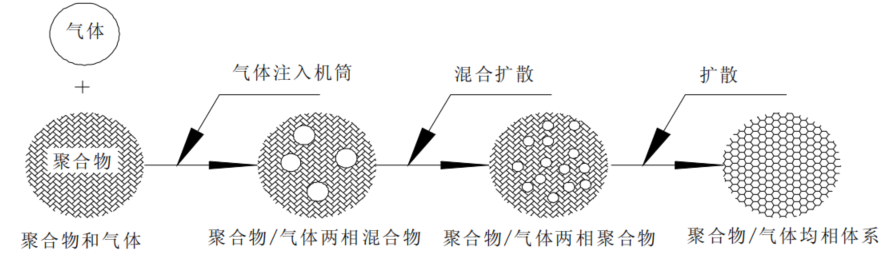
Microporous foaming usually consists of 4 stages: homogeneous system, bubble nucleation, bubble core growth and foam forming. Among them, the homogeneous system and bubble nucleation play an important role in the final microporous density and uniform distribution, and are the core stages of controlling the microporous foaming quality.
During the microporous foaming process, a saturated polymer/gas homogeneous system needs to be formed before bubble nucleation, and the bubbles are fully eliminated, otherwise the original bubbles will affect the growth of microporous nuclei, which in turn will affect the final microporous size and distribution density.
The rheological properties of the homogeneous body stage are directly related to the process effect of subsequent foaming molding, viscosity is the core parameter of melt rheological properties, and the change of viscosity will affect the subsequent pressure drop rate and non-equilibrium process, and different foaming effects can be obtained.
Both N₂ and CO₂ are suitable as supersaturated gases, with excellent chemical properties and low preparation costs, non-toxic and non-flammable, but supercritical CO₂ is superior to supercritical N₂ in terms of solubility and diffusion rate in polymers.
Therefore, under the same process conditions, supercritical CO₂ can produce more abundant bubbles, so the use of supercritical CO₂ as a supersaturated gas has been studied more. The following is an overview of the influence and mechanism of pressure on the rheological properties of melts from the aspects of pressure, temperature, CO₂ dissolution and external force field, and further clarifies the key influencing factors of rheological properties in the homogeneous phase。
1. Temperature
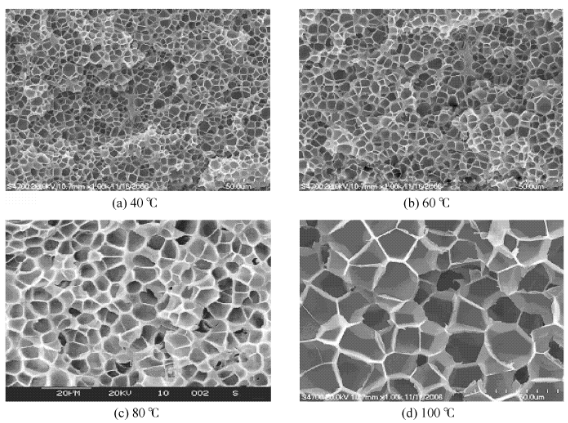
Within a certain range, the temperature reduction can strengthen the entanglement of the polymer chain, increase the energy storage modulus, produce cold shrinkage, and reduce the free volume of the polymer chain, inhibits translational motionIn turn, the melt viscosity is improved, and the pore volume is reduced and increased Bubble density to improve foaming effect.
Low temperatures also help increase CO₂ solubility,So when the temperature drops from high to low, low temperature rangeThe viscosity improvement is more pronounced because withTemperature rises, promoting CO₂It will spread at the same time Lower it in the matrixThe amount of solubility isAffect the plasticization effect. However, too low a temperature will increase the surface tension of the matrix, hinder the diffusion and homogeneous formation, and affect the molding quality, so it is necessary to choose an appropriate temperature range.
Cross-sectional morphology of microporous PMMA products at different temperatures by decompression method
Usually the temperature is selected asIt is higher than the polymer Tg (guaranteed chain segment movement) and lower than the blowing agent escape critical temperature (to avoid bubble rupture), and balances the needs of viscosity reduction, CO₂ solubility improvement and bubble structure optimization in this range. The specific needs to be determined experimentally according to the polymer type, process conditions (pressure, shear rate) and target pore morphology.
2. Stress
In the process of polymer injection or extrusion, the pressure will directly affect the polymer chain energy, increase the dynamic shear modulus, and compress the free volume between the chains, so increasing pressure usually leads to a rapid increase in viscosity, but the viscosity of different polymer melts is different in pressure sensitivity, because the difference in molecular microstructure will also cause the difference in the free volume affected by pressure.
Secondly, the increase of pressure can increase the diffusion rate and solubility of CO₂ in the melt, further increase the plasticization effect on the matrix, and affect the viscosity change of the homogeneous melt. The final formation of the bubble hole is achieved by the rapid pressure drop of the mouth mold, and the viscosity of the homogeneous body will also directly affect the pressure drop rate.
Xue et al. studied the correspondence between pressure and viscosity of PS/supercritical CO₂ melts, found that shear viscosity is an exponential function of pressure, and used the generalized Cross-Carreau model to characterize the viscosity change. Gutiérrez et al. further found that there is a logarithmic relationship between pressure increase and viscosity decrease, but the accuracy of relationship characterization decreases at higher temperature and concentration values, due to the combination of the above two opposite effects affecting viscosity changes with increasing pressure.
3. CO₂ solubility
Supercritical CO₂ has a significant plasticizing effect on the polymer matrix, reducing the intermolecular force of the matrix, reducing the melt viscosity and improving the processability of the homogeneous body. With the increase of dissolved volume, the entanglement of the molecular chain is further reduced, making the molecular chain more relaxed, the degree of freedom of the chain segment increases, and the fluidity of the homogeneous melt continues to increase within a certain CO₂ solubility range.
Secondly, supercritical CO₂ not only affects the rheological properties of homogeneous bodies, but also directly affects the foaming effectThe change of solubility will change the density and uniformity of the microporous structure, and the changes in the rheological properties of the homogeneous body will be more complex by affecting the solubility of pressure, temperature and other parameters.
In general, the supercritical CO₂ solubility can significantly reduce the matrix viscosity, but the effect tends to be unstable near the threshold. Because the dissolution volume is greatly affected by the process parameters, precise solubility control in microporous foaming equipment is still an industrial problem, such as the temperature control of the reactor depends on the external heating hysteresis is strong, and the feedback of CO₂ flow control is difficult to be practicalThe reaction stage is accurately matched, and it is not easy to obtain stable experimental results.
4. External force field
The introduction of shear or vibration during the mixing stage can help reduce the apparent viscosity of the melt, shorten the homogeneous formation time, and improve production efficiency and foaming effect. The viscosity of the homogeneous melt decreases significantly under low shear, but the effect on the viscosity of the melt gradually decreases with the increase of the shear rate. Although high shear helps to increase the density of the bubbles, it is easy to cause serious pore orientation and affect the poresQuality.
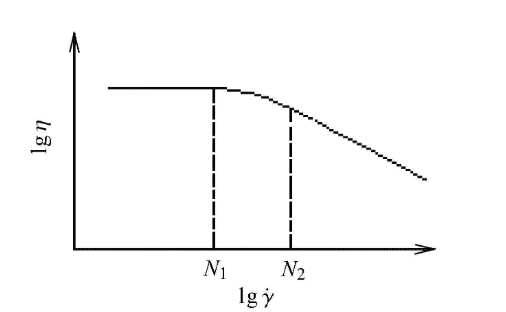
In the typical shear viscosity curve, the viscosity of polymer melt decreases significantly with the increase of shear rate, especially in the low shear rate region (before the N1 point), and then decreases rapidly, which is in line with the behavior of “shear thinning”.
The research group of South China University of Technology in China carried out the research on adding an external force field in the extrusion process with the help of electromagnetic dynamic plastic compounding equipment, which changed the energy and momentum balance state in the mixing process through vibration, reduced the viscosity and elasticity of the melt, accelerated the homogeneous phase formation speed, and helped the orientation of melt macromolecules to obtain higher extrusion product quality.